
Stablecoins for Business: A Practical Guide to Faster Cross-Border Payments
Stablecoins like USDT and USDC are becoming a practical tool for paying partners, collecting revenue, and moving money across borders. Here's how they work, where they fit, and how to use them without taking on unnecessary risk.


Why Businesses Are Paying Attention to Stablecoins
For a long time, crypto in business meant one of two things: speculation, or a payment option bolted onto a checkout that few customers used. Stablecoins have changed that conversation.
Unlike Bitcoin or Ethereum, stablecoins are designed to hold a steady value, usually pegged one-to-one to a currency like the US dollar. That makes them useful for something most businesses actually care about: moving money quickly, cheaply, and predictably across borders.
For companies paying affiliates in dozens of countries, collecting deposits from players worldwide, or paying contractors who struggle to receive international wires, stablecoins aren't a bet on crypto. They're a payment rail.
This guide covers what stablecoins are, where they make sense for a business, the risks worth understanding, and how to run them alongside your fiat operations.
What Is a Stablecoin?
A stablecoin is a digital token built to keep a stable value relative to a reference asset. The most widely used stablecoins, such as USDT (issued by Tether) and USDC (issued by Circle), are pegged to the US dollar and backed by reserves held by the issuer.
In practice, 1 USDT or 1 USDC is meant to be worth roughly 1 US dollar. You can send it to a wallet anywhere in the world, and the recipient receives the same dollar value without the price swings associated with other cryptocurrencies.
Other stablecoins exist, including ones pegged to the euro and decentralized options like DAI, but dollar-pegged stablecoins account for most business use today.
Where Stablecoins Make Sense for a Business
Stablecoins aren't a replacement for your bank account. They're one more tool, and they're strongest in a few specific situations.
Paying Partners and Contractors Globally
International wires typically take 3 to 5 days, carry fees on both ends, and sometimes don't arrive at all when intermediary banks flag them. For an affiliate network paying thousands of partners, or an agency paying freelancers across several continents, those delays and costs add up every month.
Stablecoin transfers usually settle in minutes, run 24/7 including weekends, and reach recipients in countries where receiving international bank transfers is slow or difficult.
Accepting Payments From Customers
In iGaming, online trading, and parts of the creator economy, a meaningful share of customers prefer to pay in crypto. Accepting stablecoins lets you serve those customers without exposing your revenue to the volatility of other cryptocurrencies.
Moving Funds Between Entities and Markets
Businesses with entities or teams in several regions can use stablecoins to move value between them quickly, then convert to local currency where it's needed.
Holding a Dollar-Denominated Balance
For companies operating in markets with volatile local currencies, holding part of their working capital in a dollar-pegged stablecoin can be one option for managing currency exposure, alongside traditional multi-currency accounts.
The Risks Worth Understanding
Stablecoins are useful, but they're not risk-free. Any business using them should understand the trade-offs.
Issuer and Reserve Risk
A stablecoin's value depends on the issuer's ability to back it. If confidence in the reserves weakens, a stablecoin can temporarily lose its peg. Diversifying across stablecoins, and not holding more than you need, reduces exposure.
Operational Risk
Crypto transactions are generally irreversible. Sending funds to the wrong wallet address, or on the wrong blockchain network, can mean losing them permanently. Clear internal processes and address verification matter more here than with bank transfers.
Compliance Risk
Regulators increasingly treat stablecoins like any other financial flow. Businesses need to know who they're paying and receiving funds from, screen transactions for links to sanctioned or illicit activity, and keep records that hold up in an audit. In the EU, frameworks such as MiCA are setting clearer rules for crypto service providers, and expectations around transparency continue to rise.
Banking Risk
One of the most common problems isn't crypto itself. It's what happens when crypto-derived funds hit a traditional bank account. Many banks block or question incoming transfers from exchanges, especially for businesses in iGaming, trading, or affiliate marketing. That's often where crypto operations break down.
How to Run Stablecoins Alongside Fiat
The businesses that get the most from stablecoins treat them as part of their finance operations, not a side project. A few principles help.
Decide What to Hold and What to Convert
Not every stablecoin payment needs to stay in crypto. Set clear rules: convert customer payments to fiat immediately to cover operating costs, or keep a defined portion as a stablecoin balance for payouts. Write the policy down so the decision isn't made case by case.
Separate Wallets by Purpose
Keep customer deposits, vendor payments, and treasury in separate wallets. It makes reconciliation easier, reduces mistakes, and gives auditors a clear picture.
Screen Every Transaction
Use transaction monitoring to check incoming and outgoing payments for compliance risk before they become a problem. Retroactive cleanup is far harder than screening upfront.
Keep One Source of Truth
When crypto activity lives on an exchange, fiat lives in a bank, and payouts run through a third tool, reconciliation turns into a monthly project. The fewer systems involved, the cleaner your books.
Where Neoflow Fits
Neoflow brings crypto and fiat into one compliant platform, so stablecoins become part of your everyday finance operations instead of a separate system.
- Accept crypto payments in 70+ cryptocurrencies, including USDT, USDC, and DAI, through dedicated wallet addresses or at checkout
- Convert instantly between crypto and fiat currencies like EUR, USD, and GBP, at spot rate plus a transparent margin
- Hold or auto-convert, with separate wallets and auto-conversion rules for client deposits, vendor payments, and treasury
- Pay out in bulk to 5,000+ recipients in a single CSV upload, with a different cryptocurrency per recipient
- Stay compliant with automated AML and transaction screening and full audit trails on every payment
- Spend directly by topping up corporate cards with crypto, or funding operations from your multi-currency accounts
Because your crypto and fiat run on the same platform, funds don't need to pass through an exchange and back into a bank that might block them.
Frequently Asked Questions
Are stablecoins the same as Bitcoin?
No. Bitcoin's price moves with the market. Stablecoins are designed to hold a steady value, usually pegged to the US dollar, which makes them better suited for payments.
Do I have to hold crypto to accept it?
No. With Neoflow, you can auto-convert 100% of incoming crypto to fiat immediately and avoid volatility entirely.
Can I pay my team or contractors in stablecoins?
Yes. You can pay employees and contractors in crypto through bulk payouts, or convert to fiat and pay by bank transfer.
Are stablecoin payments compliant?
They can be, with the right controls. Every transaction on Neoflow is screened automatically, with complete audit trails.
Start Using Stablecoins the Compliant Way
Stay in the Flow
Product updates, payment insights, and compliance news for fast-moving global businesses. Straight to your inbox, no noise.
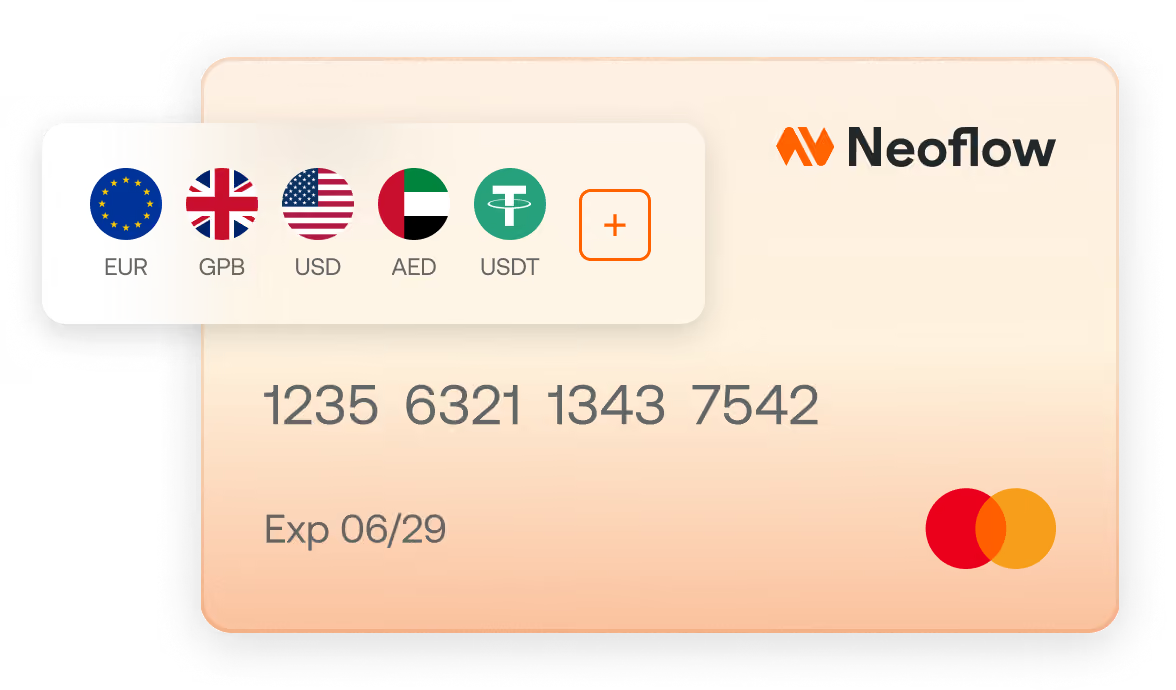
Send, receive, and convert across 40+ currencies and 70+ cryptos, without blocked transfers.
Most banks weren't built for high-growth companies. We were. Neoflow brings accounts, cards, FX, crypto, and payment acceptance into one compliant platform, with a dedicated account manager who understands your industry.

One Platform for Global Payments, Crypto, Cards, and Spend
No more fragmented solutions or banking bottlenecks. Neoflow simplifies financial operations for high-growth teams ready to scale.
No upfront commitment - explore the platform before you switch
Compliant across fast-moving and regulated industries with high growth
Hands-on migration support - from accounts to API integration
Live in 2 weeks in most cases - faster than legacy banks, with zero downtime